
What SEOPress AI is and what problem it solves in 2026
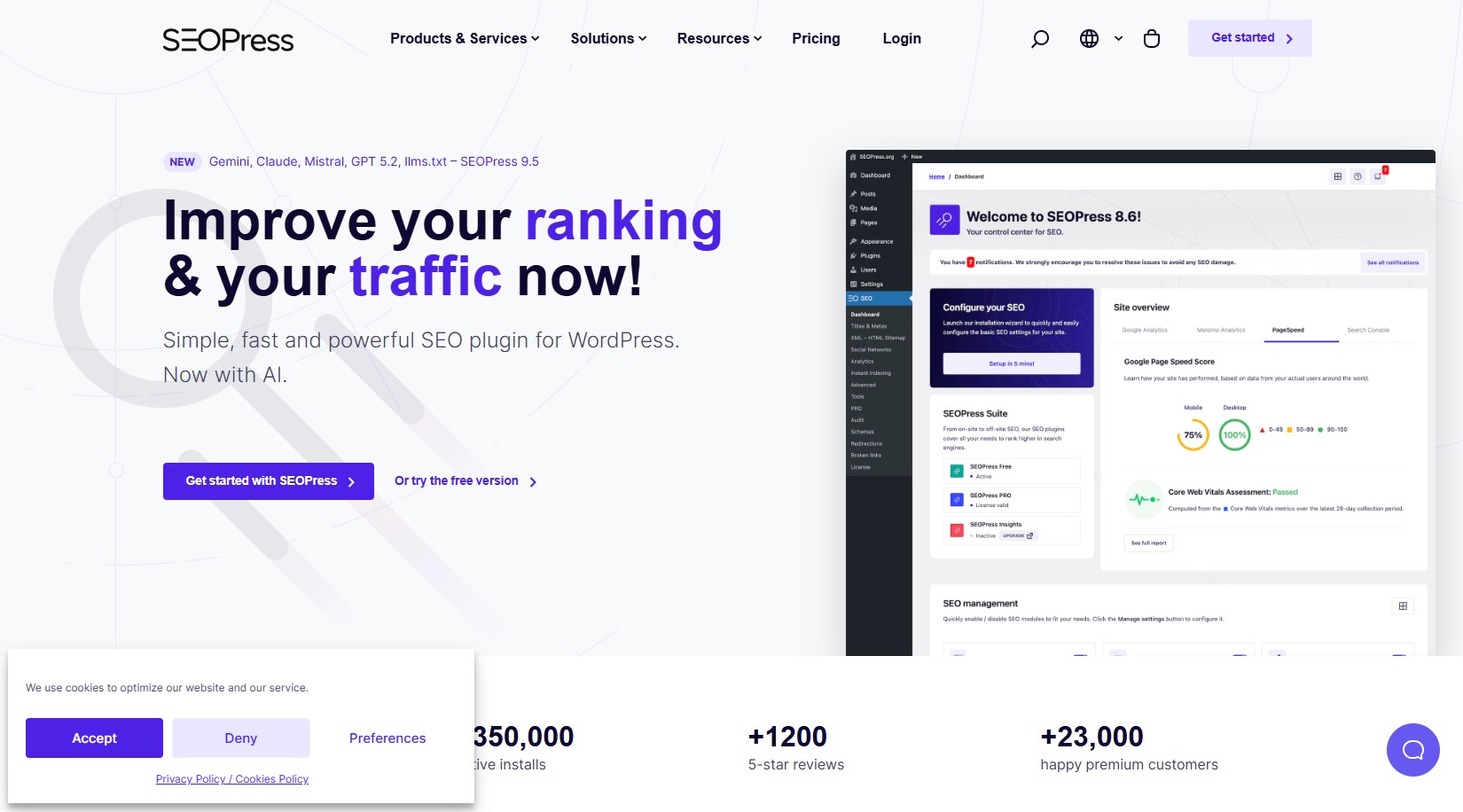
SEOPress AI refers to the AI‑powered capabilities embedded within the SEOPress WordPress SEO plugin, enabling WordPress site owners to automatically generate and optimize SEO metadata, structured content elements, and alternative texts with the help of AI models such as OpenAI’s GPT‑series, DeepSeek AI, Google Gemini, Claude, and Mistral AI. Unlike older SEO plugins that require manual entry of titles, meta descriptions, and image alt text, SEOPress AI automates and accelerates on‑page optimization right inside WordPress, saving time and ensuring SEO‑relevant elements are aligned with best practices. This matters in 2026 because content discovery and search visibility increasingly rely on both classic search ranking signals and AI‑influenced interpretation of page relevance, making metadata quality and semantic consistency more critical than ever.
Who owns SEOPress AI and the company behind it
SEOPress AI is part of SEOPress, a popular SEO plugin for WordPress developed by SEOPress, a company focused on empowering WordPress users with comprehensive, privacy‑friendly SEO tooling. The team positions SEOPress as a lightweight but powerful alternative to other SEO plugins, blending classic SEO functionalities with modern AI features that integrate seamlessly into the WordPress editor and admin interface.
How SEOPress AI actually works
SEOPress AI integrates with multiple AI provider APIs to streamline SEO workflows inside WordPress. It can automatically generate SEO metadata — such as meta titles, meta descriptions, Open Graph/X‑Tag tags, and ALT text for images — by analyzing the content of a page or post and suggesting optimized text based on keyword usage, search intent, and relevancy. These suggestions appear directly in the SEOPress meta box in the editor, and users can accept, edit, or regenerate outputs as needed. Rather than forcing users into a single AI provider, SEOPress lets site owners choose from several AI engines, giving control over cost, quality, and compliance preferences.
Real‑world use cases and how professionals use it today
SEO practitioners use SEOPress AI to save time on routine metadata generation, avoid repetitive manual optimization, and maintain consistent SEO quality across large numbers of posts or product pages. Ecommerce teams use AI to generate image alt text and schema‑ready descriptions for WooCommerce product catalogs, improving accessibility and search performance. Agencies deploy SEOPress across client sites to standardize SEO setups and reduce onboarding time, particularly when migrating from other plugins. Some teams also use SEOPress’s AI features to enhance social sharing metadata (Open Graph, Twitter Cards), ensuring click‑through‑appealing snippets across platforms.
Current pricing plans in 2026
SEOPress offers both free and premium tiers: the Free version can be installed on unlimited sites with core SEO features such as sitemaps, schema, breadcrumbs, and content analysis. The SEOPress PRO plans are priced at $49/year (1 site), $59/year (5 sites), and $149/year (unlimited sites) and include AI integration features (OpenAI, DeepSeek, Claude, Google Gemini, Mistral AI) for automated metadata and alt text generation, plus premium SEO tooling like audits, local SEO, WooCommerce SEO, schema, analytics dashboards, redirects, 404 monitoring, and support. Plugins like SEOPress Insights can be purchased as add‑ons for rank tracking and backlink monitoring at roughly $99/year per site.
How pricing compares to competitors
Compared with other WordPress SEO plugins, SEOPress’s pricing is competitive and affordable, especially given that its PRO plans include AI integrations without separate content credit subscriptions. Many competitors either lock AI features behind higher tiers or charge for AI credits (as seen with some tools that require separate credit packs), whereas SEOPress includes multi‑provider AI support in all PRO tiers. Plugins like Yoast SEO and Rank Math may offer similar AI metadata generation but often at higher price points or more complex pricing models. The Insights add‑on for rank and backlink monitoring adds cost if these analytics features are needed, making SEOPress’s modular pricing beneficial for customizable usage.
Who should use SEOPress AI and who should not
SEOPress AI is well suited for WordPress site owners, bloggers, ecommerce stores, small businesses, and agencies that want an SEO solution that integrates with their publishing workflow and automates repetitive metadata tasks. It’s particularly appealing where cost‑effective AI integration with multiple AI providers matters. It is less appropriate for large enterprise SEO programs needing advanced analytics, cloud‑native SEO dashboards, keyword research suites, and AI content briefs beyond metadata generation, where standalone SaaS SEO platforms may offer broader capabilities.
Strengths, limitations, and realistic drawbacks
Among SEOPress AI’s strengths are its tight WordPress integration, multi‑provider AI support, affordable pricing, and extensive SEO toolkit that goes beyond simple metadata automation. It respects privacy and doesn’t bloat sites with ads or unwanted scripts. Limitations include dependence on external API keys (users must manage and pay for their own OpenAI or DeepSeek usage), and its AI functionality currently centers on metadata and alt text generation rather than deep AI writing or on‑page content analysis. Some users find the initial setup of AI models slightly technical compared to turnkey solutions.
How SEOPress AI is being used in businesses and teams
Teams embed SEOPress AI into content publishing workflows where writers and editors generate optimized titles, descriptions, and social metadata as part of a routine editorial process before publishing. Ecommerce stakeholders use it to bulk generate optimized metadata for large product inventories. SEO consultants deploy SEOPress across client portfolios to maintain consistent SEO configuration and reduce manual errors during setup. Developers use SEOPress’s WP‑CLI and API hooks to automate SEO tasks as part of deployment pipelines.
Why SEOPress AI matters in the AI landscape in 2026
By 2026, AI understanding of web content has become a core part of how search engines and generative agents assess relevance, structure, and user intent. SEOPress AI matters because it brings AI‑assisted optimization directly into WordPress — the most widely used CMS globally — enabling millions of sites to produce SEO‑ready metadata and structured elements without external tools. Its multi‑provider AI support also gives teams flexibility in choosing the AI model that best fits their quality, privacy, and cost preferences.
A concise final verdict written like a human expert
In 2026 SEOPress AI is a solid, cost‑effective AI enhancement to a comprehensive WordPress SEO plugin that helps teams automate SEO metadata generation and structured content tasks directly where content is managed. It doesn’t aim to replace full standalone SEO SaaS suites with deep analytics, but for WordPress users needing practical, affordable AI assistance — especially for meta titles, descriptions, alt text, and schema — it delivers a balanced mix of automation, flexibility, and price that fits both small and mid‑sized workflows without locking users into heavy subscription fees.F