
What Plausible Analytics AI is and what problem it solves in 2026
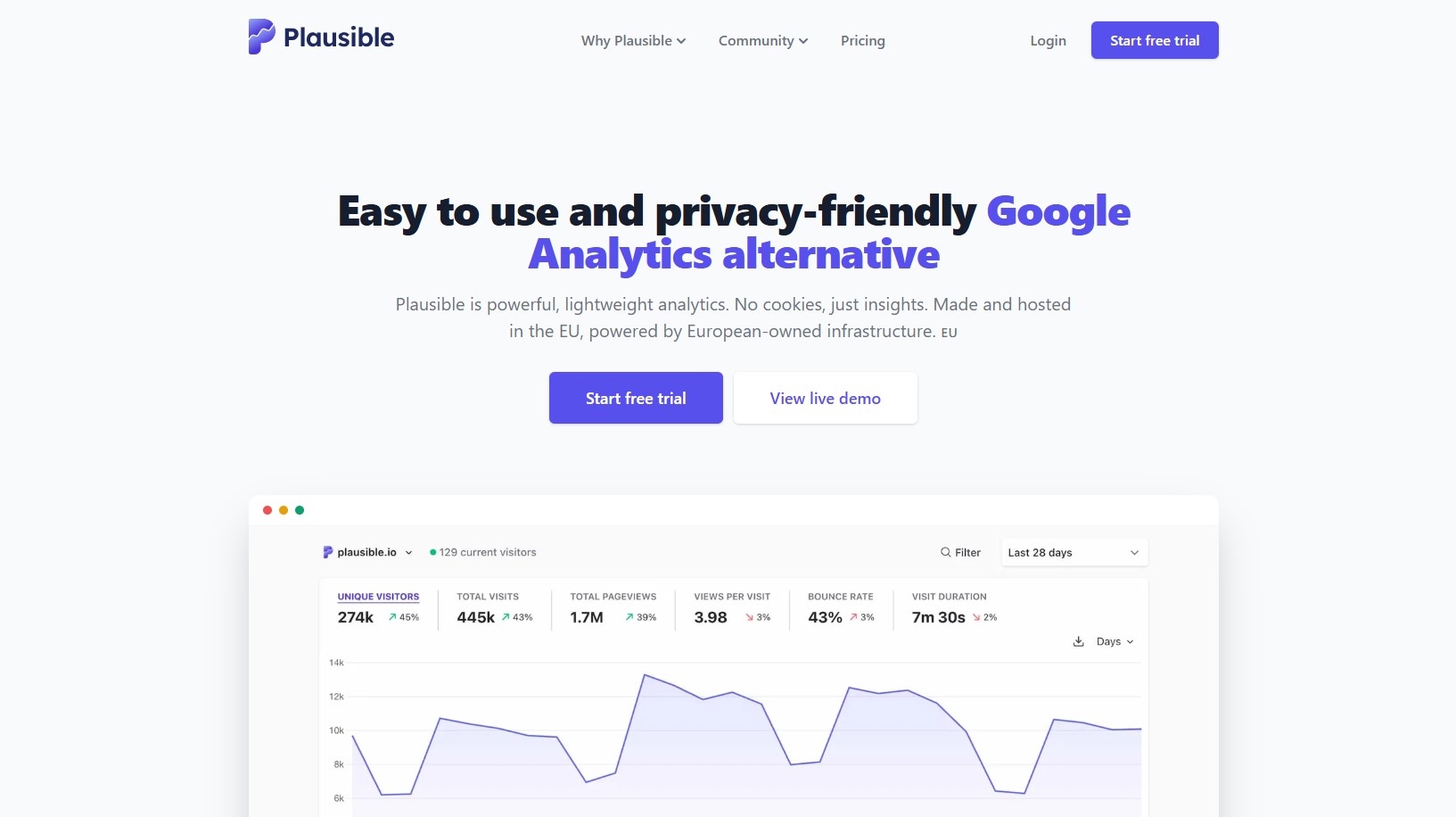
Plausible Analytics itself is a simple, lightweight, privacy-friendly web analytics platform that gives website owners clear metrics about traffic, conversions, and engagement without collecting personal data or using cookies. In 2026, Plausible has added AI-relevant analytics features — notably AI traffic identification — that help teams understand how much of their traffic comes from AI tools and assistants such as ChatGPT, Perplexity, Claude, and other generative engines that refer users to content. This matters because generative AI search and agent referrals have become meaningful traffic sources, and being able to measure that distinctly from traditional human traffic gives marketers and analytics teams actionable insight into modern discovery and engagement behaviors.
Who owns Plausible Analytics AI and the company behind it
Plausible Analytics is developed by Plausible.io, an independent, self-funded team incorporated in Estonia that builds open-source, privacy-first analytics tools. The company deliberately avoids surveillance capitalism: it does not collect personal data, does not store cookies, and does not sell or share visitor data with third parties. Plausible’s mission is to provide web analytics that respect privacy while still delivering accurate, actionable insights for website owners.
How Plausible Analytics AI actually works
Unlike traditional analytics tools that rely on cookies or personal identifiers, Plausible captures essential event data with a lightweight <=1 KB tracking snippet and aggregates it into privacy-preserving metrics. Its AI traffic identification capability flags visitors that originate from or are referred by prominent AI tools, making that traffic segment visible in dashboards and reports. This lets users see which AI ecosystems are driving visits and conversions, enabling strategic decisions about content optimization for both human and AI audiences. All data remains aggregated and anonymous, preserving privacy while still revealing patterns that matter for business decisions.
Real-world use cases and how professionals use it today
Marketers use Plausible’s AI traffic tracking to measure how content performs in generative AI ecosystems, identifying which pages draw AI referrals and which don’t. SEO teams integrate Plausible with search and campaign tracking to attribute conversions not just from search engines but from AI agents and assistants. Small businesses and creators rely on the simple dashboard to monitor visitors, goals, funnels, and AI referrals without the overhead of enterprise analytics. Agencies use Plausible’s API or raw data exports for deeper integrations into internal BI workflows.
Current pricing plans in 2026 (free, paid, enterprise)
Plausible uses a usage-based subscription model tied to monthly pageviews with a 30-day free trial and no credit card required. Plans include:
• Starter – around $9/month for ~10 K pageviews with core analytics, goals, and segments.
• Growth – around $14/month for multi-site setups and team features.
• Business – around $19/month with extended data retention, ecommerce attribution, and API access.
• Enterprise – custom pricing for advanced requirements, high API limits, SSO, and raw data exports. Larger organizations with heavy traffic or multiple sites can negotiate tailored enterprise plans.
How pricing compares to competitors
Plausible’s pricing is moderate and predictable compared with enterprise analytics suites that charge large annual fees for AI insights, data warehousing, and predictive modeling. It tends to be more cost-effective for small to mid-sized websites than tools like Google Analytics 360 or Adobe Analytics. Unlike many competitors that rely on cookie-based tracking or more invasive data collection, Plausible’s model combines privacy compliance and essential web metrics without the surveillance overhead — a practical value proposition for privacy-conscious sites.
Who should use Plausible Analytics AI and who should not
Plausible is ideal for small to medium businesses, creators, nonprofit sites, and agencies who want straightforward analytics without invasive data collection. It is especially well-suited for teams that need privacy-compliant tracking (GDPR/CCPA) and clear reporting on AI-driven traffic sources. It’s less appropriate for enterprise teams needing deep predictive AI analytics, advanced segmentation, or full BI platform integrations, where tools like Adobe Analytics or Amplitude offer richer AI-augmented modeling and cross-channel intelligence.
Strengths, limitations, and realistic drawbacks
Strengths include Plausible’s privacy-first design, lightweight implementation, simplicity, accurate real-time stats, and AI referral reporting. Its dashboard is easy to use and accessible to non-technical stakeholders. Limitations include a narrower feature set compared with large analytics platforms: Plausible does not offer deep predictive modeling, customer lifetime value AI forecasts, or complex multi-touch attribution. Metrics are intentionally focused on essential site insights rather than exhaustive analytics layers. Its AI identification features, while useful, are not as expansive as the machine-learning insights available in enterprise solutions.
How Plausible Analytics AI is being used in businesses and teams
Teams embed Plausible into content performance reviews, campaign tracking, and executive reporting. Marketing and SEO teams use AI referral data to optimize content for visibility in both search engines and AI assistants, while developers integrate Plausible with CI/CD dashboards to monitor site behavior post-deploy. Agencies use API and enterprise features to feed Plausible data into centralized dashboards across client portfolios. Its ease of sharing (filtered dashboards and segments) supports cross-team collaboration.
Why Plausible Analytics AI matters in the AI landscape in 2026
By 2026, AI-driven discovery and generative search significantly influence how users find and interact with content. Plausible Analytics AI matters because it gives clear visibility into this new class of traffic while maintaining strict privacy standards. Its ability to track AI referrals and conversions alongside traditional metrics positions it as a modern, compliant analytics solution for teams that must balance insights with user privacy in an era where AI is integral to content discovery.
A concise final verdict written like a human expert
Plausible Analytics in 2026 is a privacy-focused, lightweight analytics platform that adds AI-relevant traffic identification to essential web metrics without compromising user anonymity. It thrives for organizations that want clear, actionable insights without the complexity or privacy trade-offs of larger analytics suites. Its pricing is accessible, its dashboards easy to adopt, and its focus on modern referral sources — including AI assistants — gives context for today’s hybrid discovery landscape. While not a full enterprise analytics platform with deep machine learning models, Plausible delivers practical web analytics with AI awareness that aligns with how traffic is generated and consumed in 2026