What Fathom Analytics AI is and what problem it solves in 2026
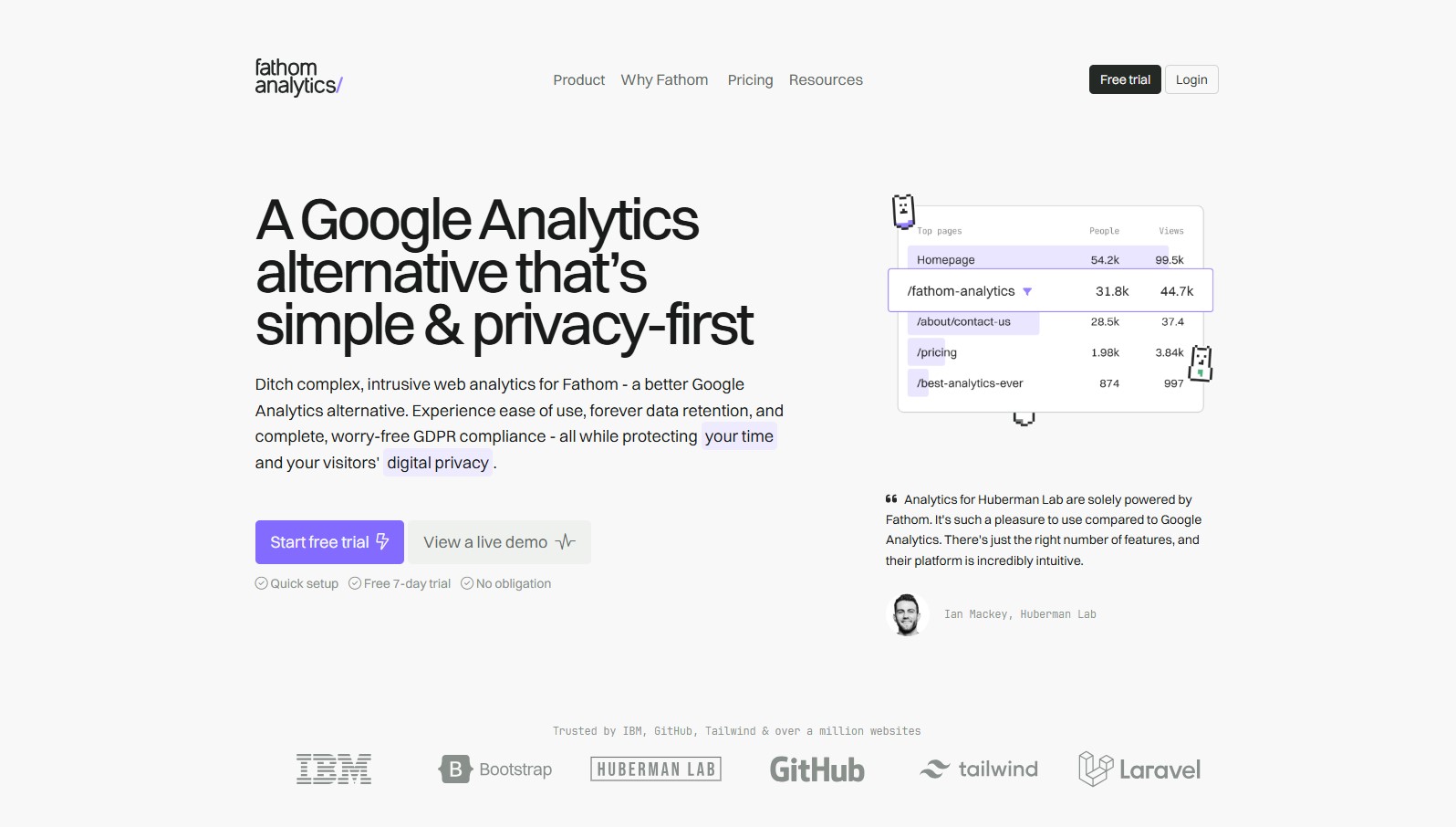
Fathom Analytics itself is a privacy-first, cookieless website analytics platform that gives teams essential insights into traffic, engagement, conversions, campaigns, and user behavior without tracking personal data or violating privacy laws. It is not a traditional AI-analytics platform with generative reports, predictive modeling, or natural-language querying like enterprise tools (e.g., Adobe Analytics AI or Mixpanel AI). Instead, its AI-relevant positioning in 2026 centers on automated bot filtering and data accuracy — sometimes loosely described as “AI traffic filtering and analytics automation” — which keeps datasets clean and human-focused. Fathom accomplishes this with advanced bot/crawler detection and simplification of analytics workflows, reducing manual noise and giving a truer picture of real human behavior rather than inflated, bot-polluted metrics. In the modern context of AI-driven discovery (e.g., traffic from search assistants or AI agents), Fathom’s presentation helps teams see meaningful trends quickly without intrusive tracking.
Who owns Fathom Analytics and the company behind it
Fathom Analytics is developed independently by a small team focused on privacy-first web analytics. Around 2026, Fathom is a paid, SaaS platform used by tens of thousands of websites worldwide as a lightweight alternative to traditional analytics offerings. Its business model explicitly avoids selling or monetizing user data; instead, it charges a subscription for analytics access so users retain 100% data ownership and compliance with laws like GDPR, CCPA, ePrivacy, and PECR.
How Fathom Analytics actually works
Fathom works by embedding a single lightweight analytics script into a site, which then captures validated traffic metrics without cookies or personal identifiers. Visitors are hashed and aggregated anonymously, and advanced filters exclude bots, crawlers, or other non-human traffic so the dashboard reflects real human sessions. Users see real-time views, referrers, device/browser breakdowns, UTM campaign tracking, and custom event goals with instant filtering. Data is processed immediately without sampling, letting teams drill into performance without long waits or inaccurate estimates.
Real-world use cases and how professionals use it today
Marketing teams use Fathom to measure content performance and campaign impact without worrying about cookie consent or privacy banners. SEO and product teams integrate its event tracking to monitor conversions like form submissions, clicks, or ecommerce actions. Agencies deploy it for clients who care about compliance and data accuracy. Because Fathom filters out bots and most automated traffic, businesses trust its metrics for decision-making, trend analysis, and reporting without inflated pageviews.
Current pricing plans in 2026 (free, paid, enterprise)
Fathom does not offer a free indefinitely free plan, but it starts with a trial and a subscription that scales with pageviews: entry plans begin around $15/month for smaller sites and increase with higher traffic volumes. Plans include multiple sites, email reports, forever data retention, unlimited exports, and API access — all while maintaining privacy-first practices. Higher tiers support larger pageview quotas and enterprise-grade infrastructure.
How pricing compares to competitors
Compared with enterprise analytics (like Adobe Analytics or GA360), Fathom’s pricing is much lower and far more predictable because it doesn’t sell data or require expensive enterprise contracts. Against other privacy-focused tools (e.g., Plausible Analytics), pricing is broadly similar — mid-range for small and medium sites but more expensive than minimal free solutions. However, the simplicity and compliance focus often justify the subscription for privacy-aware teams.
Who should use Fathom Analytics AI and who should not
Fathom is ideal for small to mid-sized businesses, creators, agencies, and developers who want straightforward, accurate web analytics without intrusive tracking or heavy configuration. It’s less suitable for large enterprises requiring predictive AI analytics, deep BI dashboards, AI-driven forecasting, or multi-touch attribution modeling — use cases better served by advanced platforms with built-in AI modeling.
Strengths, limitations, and realistic drawbacks
Fathom’s strengths include privacy-first design, simple setup, real-time insights, accurate human-focus metrics, and compliance with global privacy laws. Its limitations stem from lack of advanced AI features — it does not currently offer generative insights, natural-language querying, or predictive modeling. Some teams wanting deep cohort modeling, revenue forecasting, or AI-driven decision guidance will find it too basic for large-scale analytics.
How Fathom Analytics AI is being used in businesses and teams
In practice, Fathom is part of weekly performance reviews, campaign tracking cycles, and compliance reporting. Teams overlay Fathom data with CRM or BI platforms via API to combine privacy-assured traffic insights with other business metrics. Developers use it during rollout monitoring to ensure features affect user engagement as expected without skewing results from non-human traffic.
Why Fathom Analytics AI matters in the AI landscape in 2026
By 2026, AI-assisted search and automated discovery are significant referral sources. Fathom matters because it helps organizations maintain privacy-aligned analytics while avoiding inflated or misleading metrics due to bots or automated traffic sources. Its clear, human-focused dataset is easier for teams to interpret in a world where AI agents and automated discovery are increasingly common. Even without generative AI interfaces, its data integrity and simplicity provide a dependable foundation for analytics.
A concise final verdict written like a human expert
In 2026 Fathom Analytics remains a strong privacy-first web analytics solution with simple, accurate, real-time insights and excellent compliance for modern sites. While it doesn’t feature deep generative AI predictions or natural-language analysis, its automated bot filtering, human-traffic focus, and ethical data model make it a practical choice for teams who want trustworthy traffic metrics without violating privacy laws or relying on invasive tracking. For organizations that need advanced AI forecasting or BI-grade analytics, a more comprehensive AI analytics platform may be necessary, but for most privacy-conscious sites — from small businesses to mid-sized portfolios — Fathom offers clearly presented, actionable insights at a predictable price.