
What Amplitude AI is and what problem it solves in 2026
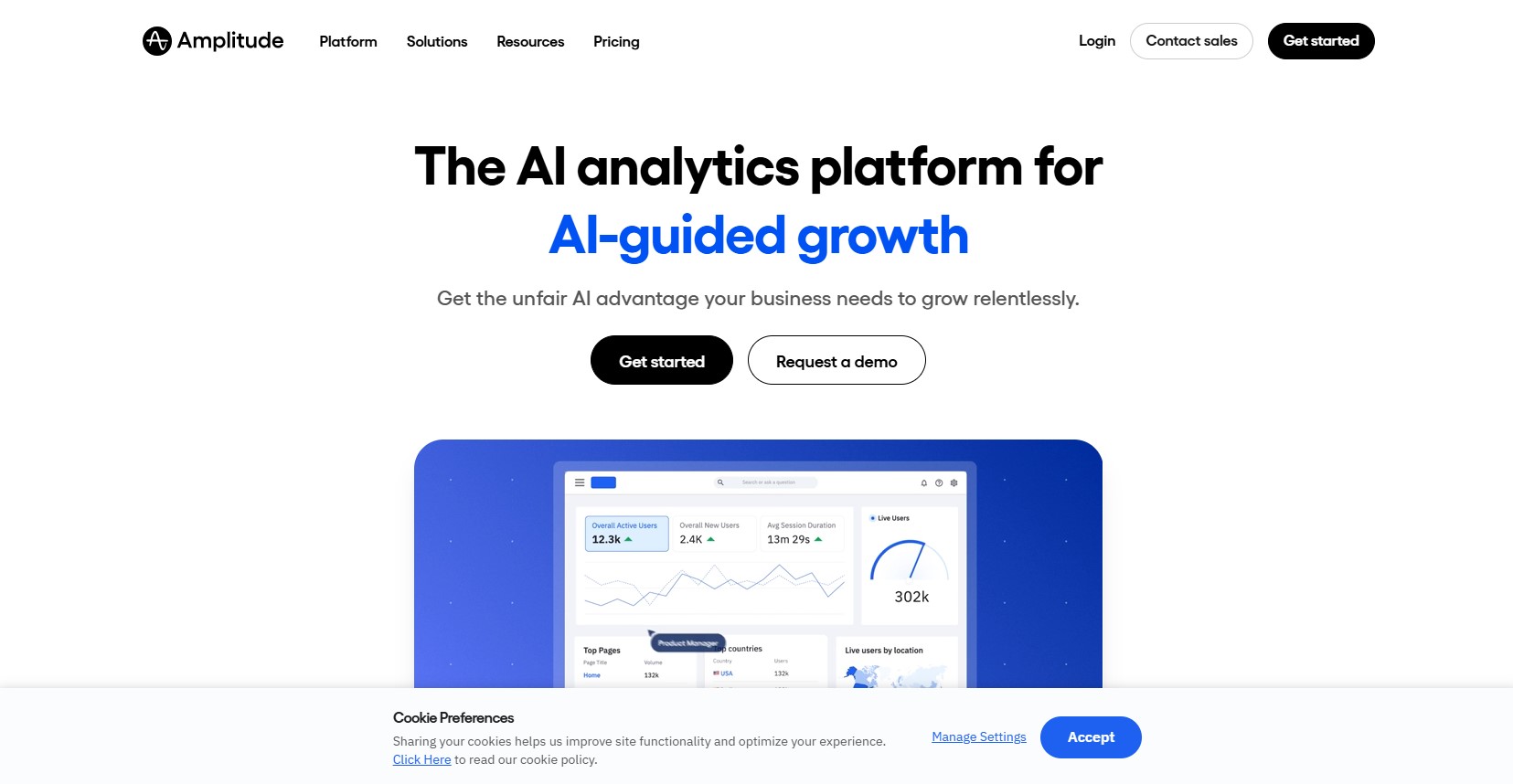
Amplitude AI refers to the artificial‑intelligence‑enhanced capabilities embedded within the Amplitude Digital Analytics Platform, a leading product and behavioral analytics solution used by teams to understand user behavior, optimize experiences, and drive growth. In 2026, as digital products and apps generate massive volumes of event‑level data, manual analysis and dashboard building becomes a bottleneck. Amplitude AI tackles this by automating insight generation, anomaly detection, experiment design, and optimization workflows, letting teams focus on strategic decisions and rapid outcome improvements rather than routine reporting. A marquee expression of this is AI Agents, autonomous assistants that monitor data, detect patterns, form hypotheses, run experiments, and help optimize experiences — all without heavy manual query construction or SQL expertise.
Who owns Amplitude AI and the company behind it
Amplitude AI is developed by Amplitude, Inc., a San Francisco‑based analytics company that specializes in behavioral product intelligence and customer journey analytics. Amplitude was founded to give product, marketing, and data teams deep, self‑service visibility into how users engage with digital experiences. Its AI features are part of the broader Amplitude Digital Analytics Platform, not a separate product, and are included within its tiered analytics offerings.
How Amplitude AI actually works
Amplitude AI operates by overlaying machine learning and generative AI on top of traditional product and behavioral analytics. Its AI ecosystem includes:
AI Agents — persistent, always‑on intelligence that monitors key metrics, detects anomalous shifts, explores user session data, formulates hypotheses, suggests (and can even run) experiments, and reports impact tailored to business goals such as conversion, retention, or engagement. Teams specify focus areas and guardrails; the agents then iterate autonomously on tasks that would otherwise require manual analysis.
AI‑assisted querying and insights — Amplitude’s AI lets users ask natural‑language questions (“Why did churn spike?”) and receive instantly generated reports, visualizations, and explanations, reducing dependency on SQL or BI support.
Integrated intelligence across analytics, experimentation, and activation — AI features blend behavioral data with session replay, A/B testing, and forecasting, helping teams understand not just what happened but why, then act on it.
Real‑world use cases and how professionals use it today
Product teams use Amplitude AI to quickly identify drop‑offs in onboarding flows and propose fixes before manual review cycles would uncover them. Marketing and growth teams employ AI Agents to run multiple experiments in parallel, test hypotheses around feature adoption, and optimize campaign impact. Analysts leverage AI for anomaly detection, catching subtle shifts in user behavior and drilling down into driving factors without building complex dashboards. Customer success and retention teams use predictive segments powered by AI to spot churn risk and tailor engagement strategies. All this accelerates decision cycles and increases data‑driven action.
Current pricing plans in 2026 (free, paid, enterprise)
Amplitude’s pricing is usage‑based and tiered:
• Free / Starter: $0, covering up to ~50,000 monthly tracked users (MTUs) and 10 million events per month. Includes core analytics such as dashboards, templates, session replay, feature flags, web experimentation, and AI Feedback.
• Plus: Starting around $49/month (billed annually) for expanded MTUs (~300K) and deeper analytics including behavioral cohorts, segmentation, custom audiences, and enhanced support.
• Growth: Custom pricing based on MTUs for scaling businesses, adding AI‑powered analysis tools, funnel and cohort depth, predictive insights, and cross‑product behavior analysis.
• Enterprise: Tailored pricing with advanced governance, compliance, premium support, larger data volumes, and full AI‑agent capabilities suited to large organizations.
AI features such as AI Agents and expanded automation are generally included or enabled based on plan and MTU volume, meaning higher tiers unlock broader AI workloads and experiment automation.
How pricing compares to competitors
Compared with full enterprise analytics suites like Adobe Analytics 360 or bespoke BI platforms, Amplitude’s pricing is more usage‑aligned and modular, often making it more accessible for startups and growth teams. Its free tier with AI Feedback and session replay is competitive with entry plans of traditional product analytics tools, while advanced AI agents at scale compare favorably against fleets of dedicated data analysts in larger organizations. Enterprise contracts may approach or exceed the cost of rivals depending on usage and support needs.
Who should use Amplitude AI and who should not
Amplitude AI is best for product, data, and growth teams in SaaS companies, mobile apps, ecommerce platforms, and digital services that need deep behavioral insights, predictive segmentation, and automated optimization workflows. It suits teams that want fast, AI‑augmented decisions without building complex pipelines. It’s less suitable for businesses that only need basic web traffic metrics (where lightweight tools suffice) or organizations that require custom, highly detailed analytical modeling outside event‑based paradigms (where dedicated BI systems might be preferable).
Strengths, limitations, and realistic drawbacks
Strengths of Amplitude AI include autonomous AI Agents, natural‑language insights, anomaly detection, and seamless integration with session replay and experimentation — all of which speed analysis and decision cycles. Its usage‑based model scales with activity levels rather than seats. Limitations include a learning curve for setup and proper event taxonomy, potential variability in AI recommendations depending on data quality, and some organizations expressing that AI insights remain assistive rather than fully autonomous — meaning human review remains essential.
How Amplitude AI is being used in businesses and teams
In real workflows, Amplitude AI is embedded into weekly product reviews, experiment planning cycles, and executive dashboards. Growth teams run AI‑guided experiments, while product managers use AI Agents to catch retention threats early. Analysts export AI‑augmented insights into broader BI systems for cross‑channel reporting. Some enterprises automate customer segment activations using Amplitude’s AI signals in outreach platforms.
Why Amplitude AI matters in the AI landscape in 2026
By 2026, analytics must go beyond static dashboards to proactive intelligence that guides action. Amplitude AI matters because it automates insight discovery and optimization workflows across the lifecycle — from data capture to experiment recommendations — enabling teams to bridge the gap between raw data and strategic outcomes. Its AI Agents in particular mark a shift toward self‑improving analytics that work in parallel with human teams.
A concise final verdict written like a human expert
Amplitude AI in 2026 is a mature, enterprise‑grade product analytics platform enhanced with AI that accelerates insight discovery, experiment design, and optimization workflows. Its strengths are in AI‑driven autonomous analysis and actionable recommendations, making it a strong choice for product and growth teams that need deep behavioral insights at scale. Pricing is usage‑aligned, giving smaller teams a path to adopt while scaling to enterprise needs. Though it still requires good event instrumentation and thoughtful governance, Amplitude’s AI features significantly reduce bottlenecks and empower organizations to move from data to action faster than traditional analytics models.