
What Mixpanel AI is and what problem it solves in 2026
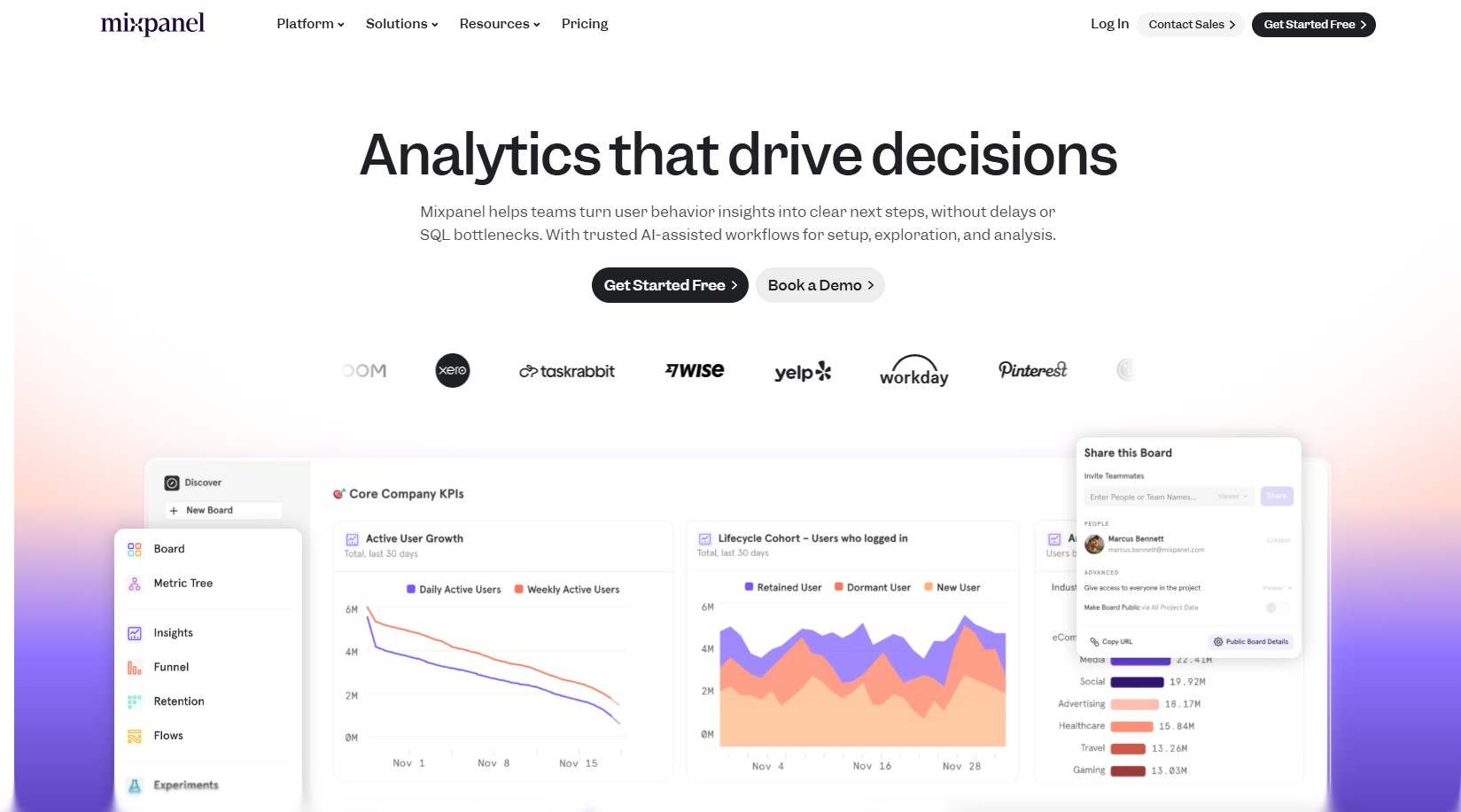
Mixpanel AI refers to the artificial‑intelligence‑augmented analytics features built into the Mixpanel digital analytics platform — a product and user behavior intelligence service used to measure engagement, retention, conversion, and other key metrics for web and mobile applications. As user data grows in volume and complexity, Mixpanel AI helps teams quickly interpret patterns, generate insights, and answer questions in plain language without bottlenecks or deep SQL knowledge, solving the persistent problem of slow, manual, and technical analytics workflows that delay decision‑making and optimization.
Who owns Mixpanel AI and the company behind it
Mixpanel AI is developed by Mixpanel, Inc., a modern product analytics company with a focus on behavioral event tracking, product metrics, and customer journey insights. Mixpanel serves product managers, marketers, engineers, and data teams across startups and enterprises, and has been growing its analytics platform with features that integrate AI‑powered query assistance, anomaly detection, and automated pattern recognition to make analytics more accessible to non‑technical users.
How Mixpanel AI actually works
Under the hood, Mixpanel AI combines behavioral event data — captured via SDKs and integrations — with machine learning and generative models to augment traditional analytics. Core implementations include Spark, a generative AI interface that lets users type questions in natural language (e.g., “What’s our retention rate last quarter by cohort?”) and automatically produces a corresponding report and visualization. Spark builds reports that are fully editable and transparent, meaning analysts can inspect and refine underlying queries rather than rely on black‑box outputs. Mixpanel also uses AI to surface automated insights, detect anomalies, suggest key drivers, and highlight patterns worth investigation, helping teams spend less time building queries and more time acting on insights.
Real‑world use cases and how professionals use it today
Teams across product, growth, and marketing departments use Mixpanel AI to accelerate analytics workflows and reduce reliance on centralized data teams. Product managers ask Spark to generate reports about feature adoption or funnel bottlenecks, saving hours of manual querying. Growth marketers use AI suggestions to identify emerging retention trends or anomalies without deep training. Engineering teams embed Mixpanel event tracking to correlate code changes with user behavior shifts, and analysts integrate AI insights into executive dashboards so stories in the data are clearer and faster to act on. Mixpanel’s AI‑enhanced functions also tie into experimentation and behavioral cohorts, enabling rapid hypothesis testing and iteration without SQL barriers.
Current pricing plans in 2026 (free, paid, enterprise)
Mixpanel’s pricing has a usage‑based model where costs scale with event volume (user interactions tracked per month). It offers a Free forever plan (up to ~1 million monthly events with core analytics and some session replay) and a Growth plan that starts at a low entry cost with additional events billed incrementally and includes more advanced analytics, unlimited reports, and a higher AI query allowance. An Enterprise plan with custom pricing supports unlimited events, advanced governance, compliance controls, and premium support. Starter tiers include a limited Spark AI query builder quota (e.g., 30–60 AI queries per month depending on plan), and Enterprise tiers increase those allowances significantly to support large teams and high‑frequency AI usage.
How pricing compares to competitors
Compared with broad, enterprise analytics suites that bundle many products (e.g., Adobe Analytics) or legacy BI platforms, Mixpanel’s pricing is more flexible and usage‑aligned, making it accessible to startups and mid‑market teams while still scaling to enterprise needs. Its usage‑based model means you pay for what you track rather than a heavy seat‑licensing model, and the inclusion of Spark AI query features even in lower tiers positions it competitively against tools where AI assistance is an add‑on. Mixpanel is generally cheaper and quicker to deploy than traditional analytics stacks requiring custom SQL and engineering support.
Who should use Mixpanel AI and who should not
Mixpanel AI is best for product teams, growth teams, SaaS companies, and digital product organizations that need rapid answers from behavior data without building complex queries or waiting on data engineers. It’s excellent where real‑time product insights and iterative optimization matter. It’s less appropriate for purely marketing analytics needs or simple website traffic tracking, where alternatives like Google Analytics (and its AI capabilities) may suffice, or for teams requiring deep custom modeling and data science support outside of Mixpanel’s paradigm.
Strengths, limitations, and realistic drawbacks
Among its strengths, Mixpanel AI offers fast, self‑serve insight generation, natural‑language report building via Spark, automated anomaly detection, and seamless integration with event tracking and session replay data — all in one analytics platform. Its intuitive interface reduces technical barriers while still supporting advanced analytics needs. Limitations include usage‑based cost variability (tracking many events can increase fees), AI query limits on lower tiers, and the fact that some advanced scenario modeling or predictive forecasting features native to full business intelligence platforms may not yet be as deep as specialized BI tools. Additionally, while generative features are helpful, they should be reviewed and contextualized by analysts to ensure accuracy and relevance.
How Mixpanel AI is being used in businesses and teams
In actual workflows, teams embed Mixpanel AI into product development cycles, weekly optimization meetings, and executive reporting processes. AI‑generated insights often trigger experiment hypotheses, such as testing a new onboarding flow when Spark flags a retention drop in a key cohort. Data teams use Mixpanel to align quantitative analytics with user session replays, helping cross‑functional teams understand not just what happened but why it happened. Growth and marketing teams sync Mixpanel data with CRM and campaign systems to connect product behavior with acquisition and revenue signals. Large enterprises also leverage warehouse connectors to blend Mixpanel data with broader business intelligence tooling for deeper cross‑platform analysis.
Why Mixpanel AI matters in the AI landscape in 2026
By 2026 traditional analytics and AI‑driven discovery converge, and teams value tools that not only collect data but interpret it intelligently and reduce analysis bottlenecks. Mixpanel AI matters because it puts AI‑driven query generation, automated insight discovery, and anomaly detection into the hands of every team member, democratizing analytics and speeding up decision cycles. This aligns with broader trends where AI augments, rather than replaces, analytical expertise, letting teams focus on strategic interpretation and action rather than formulaic querying.
A concise final verdict written like a human expert
In 2026 Mixpanel AI is a robust, product‑centric analytics platform that uses artificial intelligence to make behavioral data actionable faster and with less friction. Its generative AI features like Spark, automated insight generation, and anomaly detection help teams uncover patterns and answer questions in plain language without heavy technical overhead. While usage‑based pricing requires planning for high‑volume workloads and its predictive depth may not match some dedicated BI platforms, Mixpanel’s balanced mix of usability, AI assistance, and product analytics depth makes it a strong choice for product teams, growth marketers, and data‑driven organizations aiming to accelerate insights and improve user experiences without traditional bottlenecks.