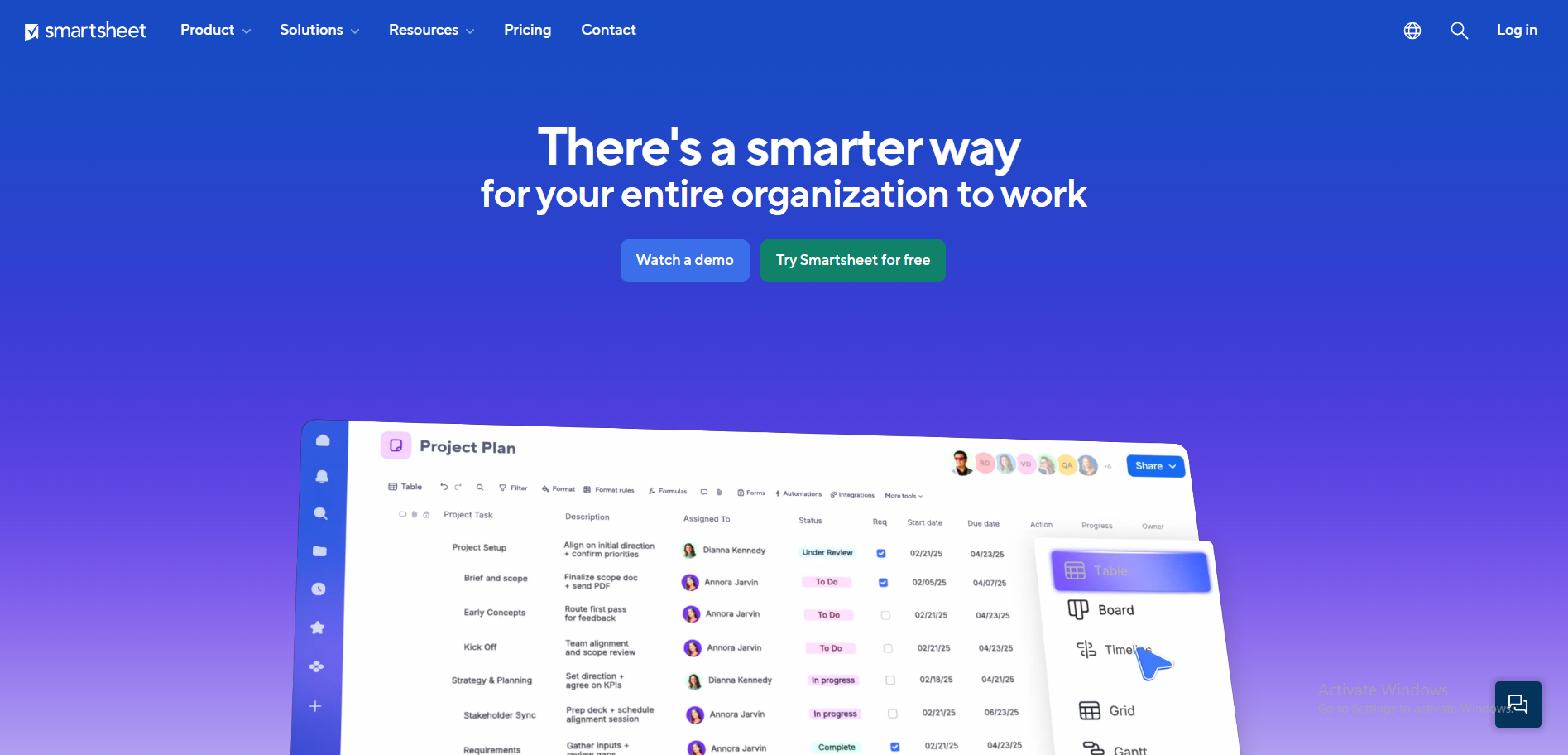

Smartsheet AI in 2026 is not a standalone “AI tool” in the way some pure‑play AI products are marketed; it is the AI‑enabled component of Smartsheet’s Intelligent Work Management platform, a comprehensive system for planning, tracking, automating, and executing work at scale across teams and enterprises. In 2026, Smartsheet AI represents how Smartsheet leverages generative and contextual intelligence to help organizations turn strategy into measurable execution with less manual effort and greater insight. This article provides an authoritative, fact‑checked overview based on the most current 2026 data, product documentation, and official sources.
Smartsheet AI solves persistent challenges in modern work environments by augmenting planning, collaboration, automation, reporting, and insight generation. Traditional project and work management tools often force teams into fragmented workflows, disconnected data, and manual setup. Smartsheet AI’s purpose is to reduce the time spent on repetitive tasks, bridge the gap between data and decision‑making, and provide contextual guidance embedded within work processes rather than as a separate intelligence silo. This shift reflects the broader 2026 enterprise demand for systems that unify people, data, and AI into a single execution engine rather than ad‑hoc analytics or reporting add‑ons.
Smartsheet itself is owned and operated by Smartsheet Inc., a technology company headquartered in Bellevue, Washington, United States. Founded in 2005, Smartsheet grew into a widely used work management platform serving organizations of all sizes. In late 2024, private equity firms Vista Equity Partners and Blackstone completed an approximately $8.4 billion acquisition, taking Smartsheet private in early 2025. Under this new ownership structure, Smartsheet continues to operate with the same brand and product focus, now supported by long‑term investment from Vista and Blackstone to expand the platform’s capabilities, including AI and automation.
At its core, Smartsheet AI works by integrating large language models (LLMs) with an organization’s existing Smartsheet data, governed by enterprise security and privacy standards. The AI layer uses a Knowledge Graph that contextualizes data, relationships, and workflows to deliver personalized insights and actions relevant to users’ roles and teams. Rather than being a generic chatbot, Smartsheet AI operates in the context of project sheets, dashboards, and workflows so that natural language requests translate into useful work outcomes—such as generating formulas, analyzing data trends, summarizing content, and suggesting next steps. Enterprise governance for AI usage is provided through a central Smart Hub, allowing administrators to oversee usage, integrations, and policy enforcement.
In practice, professionals use Smartsheet AI across varied real‑world scenarios. Project managers leverage it to turn plain‑language prompts into complex formulas and automated workflows that would otherwise require technical expertise. Operations teams use AI to auto‑categorize and translate data or to generate real‑time insights and charts for dashboards without manual scripting. Marketing and creative teams use it to create concise summaries or asset descriptions directly from project data. Larger enterprises embed AI into governance controls, using it to enforce policies and scale consistent execution across global portfolios. Smartsheet AI is becoming particularly useful where multiple teams must coordinate complex work that blends strategy, execution, and measurement.
As of early 2026, Smartsheet’s pricing structure includes a range of plans from free trials to enterprise‑level subscriptions, each with different access to AI capabilities. While pricing is subject to change and often customized for larger organizations, current public information shows that Smartsheet offers a free tier with limited functionality, a Pro plan starting around $9 per user per month, a Business plan around $19 per user per month, and Enterprise plans with custom pricing that include advanced features and AI capabilities. Some AI tools are included at certain tiers, while others may require eligibility at the Business or Enterprise level. Pricing on the official Smartsheet site reflects this tiered structure with feature gating based on plan level. Compared with competitors, Smartsheet’s pricing sits roughly in the same range as mid‑to‑high‑tier offerings from platforms like Asana, Jira, and Microsoft Project, where enterprise AI features are typically bundled into the higher‑end plans rather than available in entry‑level subscriptions.
Not every organization needs Smartsheet AI. It’s ideally suited for mid‑sized to large teams and enterprises that manage complex, cross‑functional work and require integrated AI within structured workflows. Organizations with heavy collaboration, governance, and reporting needs benefit most. Smaller teams with basic task lists or those already embedded in simpler project management tools may find Smartsheet’s pricing and learning curve less compelling. Likewise, organizations that cannot centralize data due to regulatory or security policies might need customized solutions outside Smartsheet’s standard offerings.
Smartsheet’s strengths include deep integration of AI into everyday work, a familiar spreadsheet‑like interface with modern automation, and strong enterprise governance. Realistic drawbacks stem from the complexity of the platform for novice users, potential pricing escalation as teams scale, and documented customer support challenges in some cases, particularly during onboarding or technical issue resolution. These limitations are common with broad, enterprise‑oriented platforms that balance depth of capability with usability. Independent user feedback occasionally highlights friction points in implementation and support responsiveness, indicating that organizations should plan for professional services or dedicated internal champions during rollout.
Across businesses and teams, Smartsheet AI is increasingly embedded as the intelligence layer that bridges strategy and execution. IT organizations use it to automate complex workflows and integrate with external tools such as Microsoft Copilot or Atlassian systems. Portfolio managers rely on AI‑derived insights to adjust priorities in real time. Operational leaders use it to maintain visibility across distributed work, and PMOs use it to enforce cross‑project standards and governance.
In the 2026 AI landscape, Smartsheet matters because it demonstrates how AI can move beyond isolated assistants into work engines that contextualize intelligence within operational systems. Instead of external tools that provide insights in separate interfaces, Smartsheet AI delivers contextual guidance embedded directly where work happens, thereby reducing friction and improving decision quality across diverse teams.
In a final expert assessment, Smartsheet AI represents a mature, enterprise‑ready application of generative and contextual AI within work management. It is not a standalone AI product but part of a broader intelligent execution platform that helps organizations unify data, teams, and automation under a governed AI umbrella. While its complexity and pricing may not fit every use case, for enterprises seeking to scale work management with embedded intelligence, Smartsheet remains a credible and strategic choice in 2026.