
In 2026 ServiceNow AI refers to the suite of artificial intelligence technologies embedded throughout the ServiceNow Now Platform that enable intelligent automation, workflow orchestration, and autonomous action across enterprise processes. At its core, ServiceNow AI shifts AI beyond simple assistance or chatbot interactions and toward agentic workflows—systems of multiple AI agents that understand context, execute tasks, and coordinate with other systems to complete complex business processes. The technology is designed to solve one of the fundamental challenges enterprises face in 2026: reducing operational friction while connecting siloed data, automating repetitive tasks, and enabling teams to focus on high-value work rather than manual process execution. ServiceNow’s latest innovations, such as AI Agent Orchestrator and AI Agent Studio, are built directly into the platform so organizations can deploy, regulate, and scale intelligent automation without assembling multiple disparate tools. These agents can learn from structured and unstructured data, communicate with each other, and carry out cross-system workflows—for example, onboarding staff across HR and IT systems or resolving a network security incident in a coordinated way—reducing the need for human intervention in routine, repetitive work. The platform’s unified architecture also ensures AI agents work with consistent data governance and across existing systems of record.
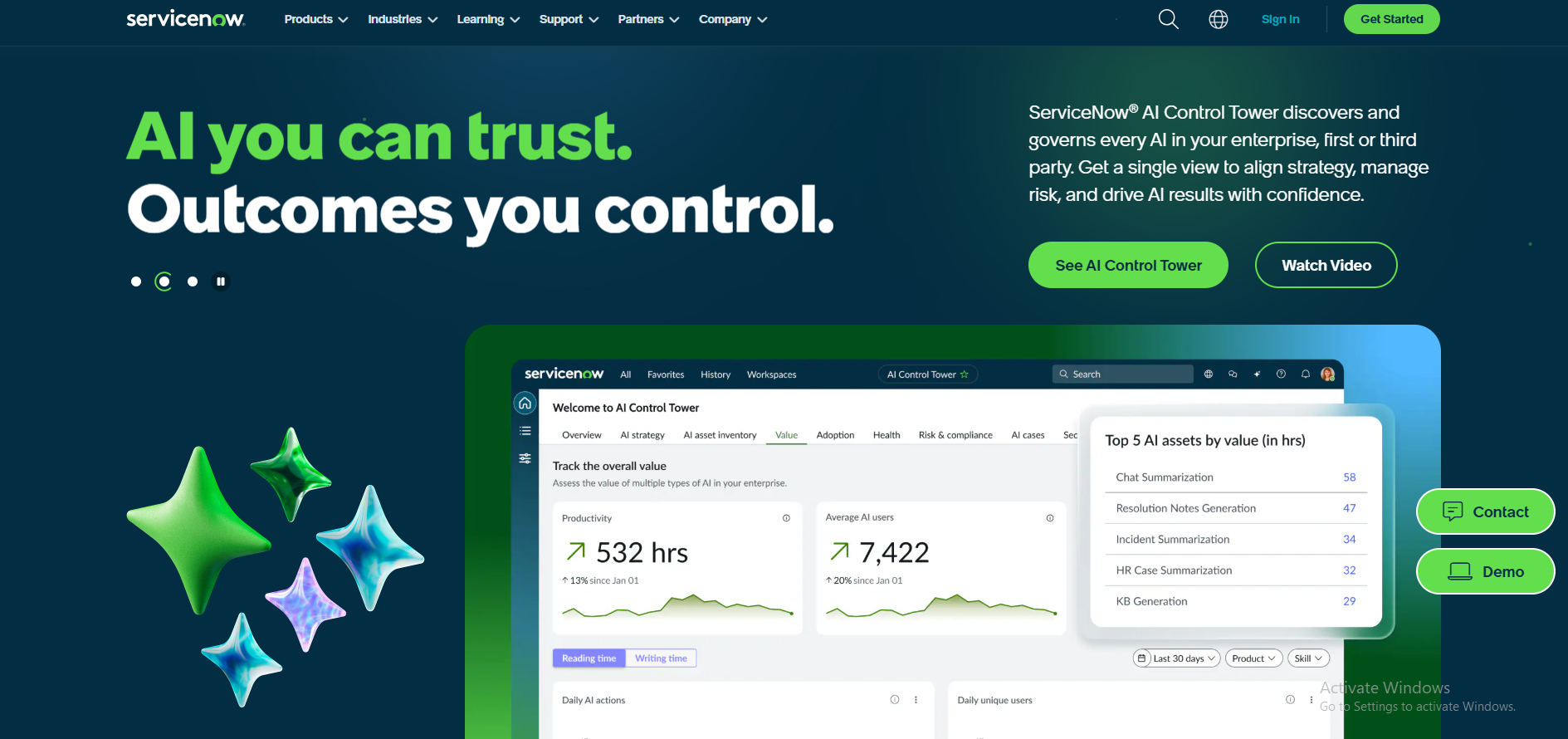
ServiceNow AI is owned and developed by ServiceNow, Inc. (NYSE: NOW), a publicly traded enterprise software company headquartered in Santa Clara, California. ServiceNow began as an IT service management provider but has evolved into a broad digital workflow platform that spans IT, HR, customer service, security, and business operations. As of 2026, ServiceNow positions itself as an “AI control tower” for business reinvention—a platform that orchestrates intelligence and execution across an organization’s workflows. In recent years, ServiceNow has deepened strategic partnerships with major AI model providers, including a multi-year collaboration with OpenAI to embed frontier AI models and provide customers with access to advanced AI capabilities such as speech-to-speech and natural language engagement natively within the platform.
ServiceNow AI works by integrating AI models and autonomous agents into the underlying workflow infrastructure of the Now Platform. Practically, this means ServiceNow builds AI agents that are trained on workflow context, data from enterprise systems, and built-in automations already present on the platform. These agents can interpret natural language requests, access multiple data sources within an enterprise instance, and perform actions such as categorizing incidents, generating customer responses, or completing fulfillment tasks across systems. AI Agent Studio allows organizations to design, test, and deploy custom agents tailored to business needs, while AI Agent Orchestrator manages coordination among groups of agents so they can communicate and work together toward common goals. What differentiates ServiceNow AI from basic generative tools is that the platform connects AI models with real-time enterprise data and existing workflows, so actions are governed, auditable, and aligned with business logic. The integration of partners like Microsoft and Anthropic alongside native ServiceNow models also gives organizations the flexibility to match the right AI model with the right task while maintaining consistent governance and risk controls.
Real-world use cases of ServiceNow AI in 2026 span common enterprise workflows. In IT service management, agents can triage and resolve service tickets automatically, freeing up human support engineers to handle more complex issues. In HR, AI can automate onboarding by coordinating account creation, equipment provisioning, and orientation scheduling across teams. In customer service, voice-enabled AI agents handle inquiries, update records, and escalate issues as needed without direct human involvement. Agents also support CRM enhancements, using AI to generate quotes, summarize customer interactions, and streamline fulfillment processes without manual input. Across security and compliance, strong governance frameworks ensure agents act within predefined policy boundaries, and integrations with identity systems help monitor permissions and automate risk responses. Adoption at major enterprises is growing, with customers across industries applying ServiceNow AI to reduce operational costs, increase responsiveness, and augment workforce productivity.
Pricing for ServiceNow AI in 2026 remains complex and largely enterprise-oriented, with no simple publicly listed cost for all features. ServiceNow does not publish flat rates for its AI capabilities; pricing is typically tied to subscription licenses for Now Platform modules (such as ITSM, CSM, HRSD) and customized enterprise agreements. Advanced AI features, such as Now Assist and AI agents, are generally included with higher-tier plans like Pro Plus and Enterprise Plus, with consumption-based elements that may factor in usage and scale. Some products and agent extensions may carry additional subscription terms or usage commitments. Historically, organizations adopting ServiceNow’s AI platform have faced significant consulting, implementation, and configuration costs on top of licensing fees, especially for tailored workloads and enterprise rollouts. This pricing structure reflects the platform’s turnkey integration with broad enterprise workflows rather than a simple pay-per-seat model.
Compared to competitors in 2026, ServiceNow AI’s pricing tends to be more opaque and enterprise-targeted. Platforms like Microsoft Copilot Studio offer simpler entry pricing structures and transparent usage models (for example, low per-interaction rates or tiered subscriptions), making them easier to evaluate for specific tasks or smaller teams, though they may require additional Microsoft 365 commitments. Other competitors, such as Salesforce’s agentic AI offerings, also embed pricing into broader CRM suites and can carry premium costs tied to CRM licensing. ServiceNow’s value proposition is its deep integration with end-to-end workflows and governance, but this also means organizations should plan for larger project scopes and longer deployment cycles.
Who should use ServiceNow AI? Enterprise organizations with complex, cross-departmental processes and existing investments in the Now Platform will find the most value. IT operations, HR service delivery, customer support organizations, and security teams can leverage AI to automate work that spans multiple systems and requires coordination. Companies that prioritize governance, compliance, and secure data handling also align well with ServiceNow AI’s design principles. Conversely, small to midsize businesses with limited workflow complexity or narrow automation needs may find ServiceNow’s approach and pricing too heavyweight relative to lighter, more modular AI tools from other vendors. Organizations lacking a mature internal process framework may struggle to justify the scale and cost of deployment.
Its strengths in 2026 include deep workflow integration, enterprise governance, and agent orchestration across systems. ServiceNow AI’s limitations are rooted in implementation complexity, pricing opacity, and steep learning curves for administrators and developers. Anecdotal reports from practitioners highlight early product maturity challenges, documentation gaps, and the need for ongoing configuration to stabilize agent behavior—especially when customizing agents for unique use cases. These real-world experiences suggest that while ServiceNow AI can deliver significant automation value, it requires skilled teams and robust change management to realize that potential fully.
In the broader 2026 AI landscape, ServiceNow AI matters because it exemplifies the shift from isolated generative assistance toward enterprise-grade autonomous workflows. Organizations increasingly expect AI not just to respond to queries but to act with context, connect disparate systems, and execute decisions in line with corporate policy. ServiceNow’s platform, with its AI Control Tower concept, positions it as a central orchestrator of AI work across business units—helping large enterprises manage distributed agent networks while maintaining governance and compliance. This aligns it with wider industry trends that emphasize responsible, integrated AI rather than siloed point solutions.
In final assessment, ServiceNow AI is a powerful enterprise workflow AI platform with a clear vision for agentic automation. It excels where deep integration and governance matter, but it also demands significant planning, investment, and expertise. For large organizations committed to digital transformation at scale, it represents a compelling choice. For smaller teams or isolated use cases, simpler, more transparent alternatives might offer better initial value.