Workato in 2026 is one of the most mature enterprise integration and automation platforms available, positioned squarely at the intersection of intelligent automation, application integration, and AI-driven orchestration. Unlike simple task automation tools or legacy middleware, Workato’s platform combines a cloud-native integration-platform-as-a-service (iPaaS) with advanced capabilities that let organizations build, monitor, and govern complex workflows and AI-powered agents across hundreds to thousands of systems simultaneously. In today’s enterprise IT stack, Workato solves the persistent problem of how to connect disparate applications, data stores, and processes into cohesive, automated business operations that both humans and AI agents can safely execute. This is increasingly critical as companies adopt large language models and intelligent agents that need real-world context and secure access to enterprise systems.
Workato is owned and operated by Workato, Inc., an American software company headquartered in Mountain View, California. Founded in 2013 by Vijay Tella, Gautham Viswanathan, Harish Shetty, and Dimitris Kogias, the company has grown into a leader in enterprise automation and integration platforms, backed by investors including ServiceNow, Altimeter Capital, Insight Partners, and Redpoint Ventures. Workato remains privately held in 2026 and has expanded globally, supporting organizations across industries with automation and integration requirements.
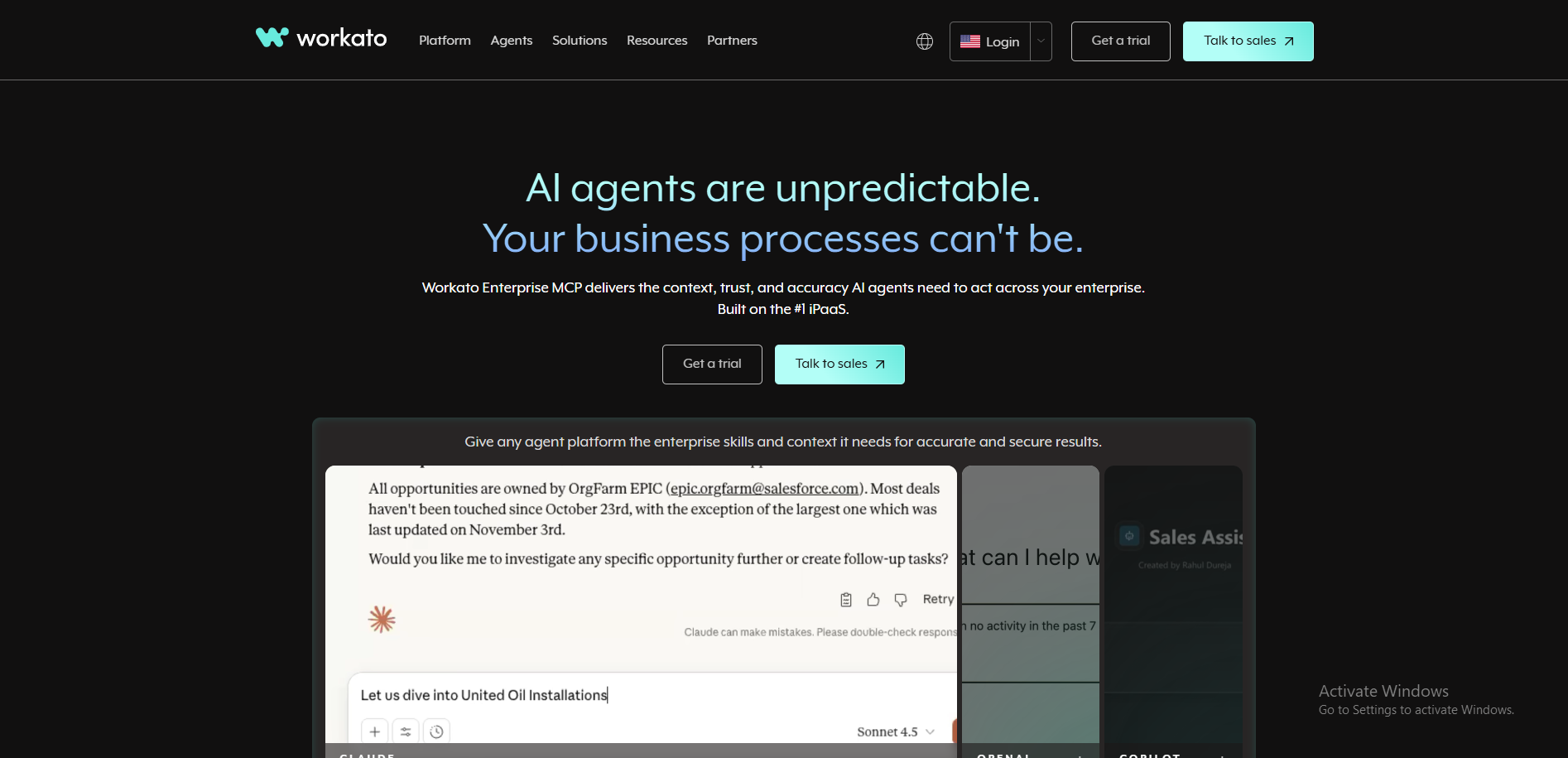
At its core, Workato’s technology works by letting users define automated workflows—traditionally called “recipes”—that connect triggers and actions across different applications. These recipes can be assembled through a low-code, visual interface where business users and IT teams alike specify events (like a new CRM lead), choices, and corresponding actions across connected systems. With built-in connectors for over a thousand applications and support for APIs, databases, and legacy systems, the platform executes workflows automatically at scale, moves data securely, and enforces governance. Beyond traditional automation, Workato has introduced its Enterprise Model Context Protocol (MCP) framework to provide context, identity, and governance for AI agents. MCP lets generative and agentic models safely interact with apps and data, creating predictable, auditable actions rather than freeform API calls. This approach enables what Workato calls “agentic automation”—where AI models execute multi-step processes with enterprise controls, audit logs, and governance baked in.
Real-world use cases reflect this breadth. In sales and marketing, organizations use Workato to sync leads, update customer records, and trigger downstream follow-ups automatically. Finance teams automate invoice approvals, expense reconciliations, and data consolidation. HR teams automate onboarding, employee provisioning, and compliance tasks. IT and operations teams deploy integrations across service desks, CI/CD pipelines, and system monitoring tools. With the addition of agentic capabilities, teams are now building AI “Genies” that not only recommend actions but execute them across tools like CRM, ERP, and support systems with governance and context awareness. These use cases underscore an evolution from simple workflow automation to orchestrated enterprise processes that span departments and systems.
Pricing for Workato in 2026 continues to be custom and usage-based rather than published as fixed tiers. The company typically builds quotes around a combination of platform edition fees and usage fees measured in tasks or automation volume. Organizations must contact Workato’s sales team for a tailored quote, and the costs can vary dramatically with the number of connectors, tasks, environments, and governance features required. Typical enterprise deals often range from mid-five-figure to six-figure annual contracts depending on scale and complexity, with larger Enterprise or Workato One editions commanding higher fees and more advanced capabilities. Some third-party reviews suggest approximate starting points for team and professional plans in the low thousands per month, with enterprise pricing requiring bespoke contracts. Workato does not offer a completely public free tier, though limited demos or sandbox access may be available on a case-by-case basis.
Compared with competitors such as Boomi or other iPaaS and automation tools, Workato’s pricing model is less transparent and more bespoke, which can make cost comparisons difficult for prospective customers. Tools like Boomi or Celigo sometimes offer clearer pricing bands or more predictable costs for simpler workloads, while Workato’s consumption-based model becomes cost-effective at scale but may feel opaque for smaller teams. The breadth of capabilities, particularly around AI governance and agentic automation, also positions Workato differently than cheaper, task-limited automation solutions.
Workato is best for medium to large enterprises with complex integration needs, multi-department workflows, strict governance or compliance requirements, and teams ready to manage enterprise-grade automation. It is less suited to very small businesses or solo users who may find the pricing and platform complexity overkill for basic automation tasks, where simpler tools could suffice. Teams without dedicated IT or integration resources may face a steeper learning curve, particularly when deploying advanced agentic capabilities.
Among its strengths, Workato offers extensive connectivity, strong enterprise governance and security, and leading support for AI workflows that combine human and agent actions. Its enterprise-grade architecture, observability, and compliance features make it attractive for regulated industries and large organizations. Limitations include pricing complexity, potentially steep costs for high-volume tasks, and a learning curve for advanced integrations. As automation requirements grow more sophisticated, the lack of public pricing transparency can also slow initial evaluation and budgeting.
In business environments, Workato is used not just by IT and operations teams but increasingly by line-of-business leaders who need automation tied directly to outcomes. This includes revenue operations, customer success, finance transformation, and supply chain orchestration. The addition of agentic automation through MCP and Genies means businesses can delegate not just repetitive tasks but context-aware, multi-system actions to AI agents with governance, audit trails, and security controls. This shift reflects broader trends in enterprise AI adoption where control, auditability, and integration are as important as raw AI capability.
Workato matters in the 2026 AI landscape because it embodies the convergence of integration, automation, and enterprise-grade AI orchestration. As companies move beyond isolated AI experiments to operationalize intelligence at scale, platforms that offer governance, security, and context for AI actions become indispensable. Workato’s focus on agentic automation and Model Context Protocol implementation represents a strategic approach to embedding AI into core business processes without sacrificing control.
In my assessment, Workato in 2026 stands as a strong choice for organizations seeking a comprehensive integration and automation platform that can support complex workflows and emerging AI-driven processes. Its power comes with complexity and cost, meaning it is most effective in environments where scale, governance, and cross-system orchestration justify the investment. For enterprises ready to move beyond basic automation to agent-enabled workflows, Workato represents one of the most capable platforms available, but smaller teams and simple use cases may be better served by lighter, more predictable alternatives.